Building with UCP: what HobbyStack taught us about the Shopify Global Catalog
TL;DR
HobbyStack is a dream-setup builder on Next.js that searches the Shopify Global Catalog via UCP, ranks gear into Entry / Enthusiast / Pro tiers, and hands checkout to each merchant. Here is why that pattern matters for developers and merchants alike.
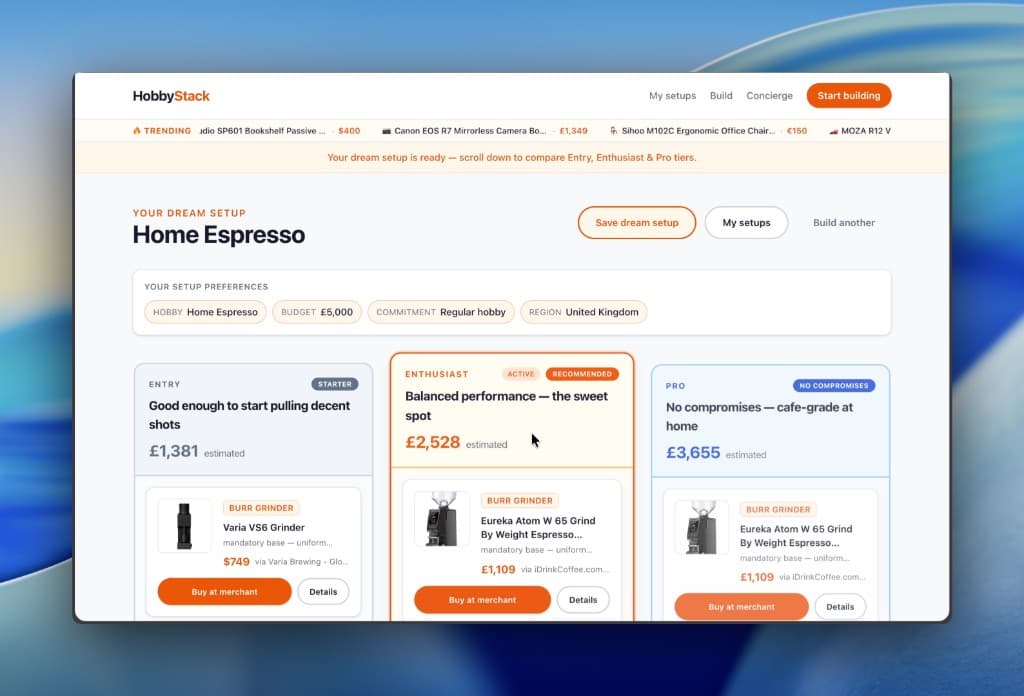
Shopify's Universal Commerce Protocol (UCP) and Global Catalog turn a familiar problem on its head: instead of scraping storefronts or wiring one merchant API at a time, you can search live product inventory across the network, then hand the buyer to the right merchant for cart and checkout.
We put that idea to work in HobbyStack, an affiliate-driven dream setup builder for high-income hobbyists. Tell it your hobby, budget, and experience level; it engineers a curated three-tier stack (Entry, Enthusiast, Pro) from Global Catalog results and sends each "Buy" action to the selling merchant.
This post is a short field note for other developers: what we built, why the pattern is interesting, and how merchants benefit when their catalogue shows up in new surfaces like this.
The product idea in one sentence
Not another product finder. HobbyStack is a rules-plus-catalog engine: deterministic hobby logic picks the right roles in a setup (espresso machine, burr grinder, water filtration), then UCP Global Catalog search fills those roles with live, buyable products.
There is no product database to maintain. The stack stays fresh because the catalog is live. Cart and checkout stay with the merchant, which is exactly where trust, inventory, and conversion already live.
Stack we shipped on: Next.js (App Router), Tailwind, and the UCP CLI / Global Catalog for search, affiliate placements, and merchant handoff.
Why UCP + Global Catalog changes the builder playbook
Before UCP, a multi-merchant "build me a kit" product usually meant:
- Fragile scrapers or partner-only feeds
- Stale prices and availability
- Custom checkout glue per brand
With Global Catalog search you reverse that:
- Discover across merchants with a query, locality context, and hard filters (price, availability, region).
- Rank and group in your own product logic (HobbyStack's three tiers and hobby rules).
- Handoff buy intent to the merchant that actually sells the SKU, via UCP where supported, or a graceful merchant-hosted flow when it is not.
That split is the unlock. Your app owns curation and UX. Merchants own commerce. Affiliate / placement economics can sit in the middle without you becoming a marketplace warehouse.
What developers should steal from this pattern
If you are eyeing UCP for your own surface, HobbyStack's shape is deliberately simple:
- Own the intent model. Budget, hobby, experience, and region are your moat, not a mirror of Shopify Admin.
- Treat catalog search as a dependency, not a data dump. Cache lightly, re-query when the buyer changes constraints, and never invent stock or price.
- Design for handoff early. The "Buy at merchant" moment is the product. If that click feels broken, the clever curation does not matter.
- Keep persistence optional. We proved a useful MVP with deterministic rules + live catalog and no product DB. Add accounts and saved setups when retention demands it, not before search quality works.
Official direction lives in Shopify's agentic / catalog docs and the UCP CLI skill path (ucp catalog search, merchant discover, cart/checkout against --business). Start with global search; graduate to merchant-scoped flows when the buyer has chosen a seller.
How merchants win when they show up here
This is not only a developer toy. For merchants on the Global Catalog:
- New discovery surface. Buyers arrive mid-intent ("I need a £2.5k home espresso stack"), not cold from a homepage bounce.
- You keep the sale. Cart, discounts, fulfilment, and brand experience stay on your storefront.
- Assortment stays authoritative. Price and availability come from the catalog, so you are not fighting a stale affiliate CSV.
- Complementary demand. A curated stack often includes your hero SKU plus accessories from elsewhere; you still capture the lines you sell.
In short: UCP surfaces are a distribution layer, not a competitor storefront, if your products are catalogued and your handoff path is healthy.
A practical invitation
If you build Shopify apps, theme tooling, or agentic shopping UX, HobbyStack is a concrete proof that Global Catalog + a sharp intent UI is enough to ship something people can use in minutes.
Clone the mental model, not necessarily the hobby vertical:
- Fitness "gym-in-a-box" under a budget
- Photographer starter kits by genre
- Workshop / maker benches by square footage
Search live. Curate honestly. Hand off checkout. That is the UCP bargain, and both sides of the counter benefit when it works.
Try the live build: hobbystack.co.uk
Screen Studio walkthrough: Portfolio · HobbyStack
Building something similar and want a second pair of eyes on catalog search, handoff UX, or Next.js wiring? Book a short consultation. We are actively shipping on this stack.