How to Calculate True Profit per Order on Shopify Before Black Friday 2026
TL;DR
Revenue and ROAS can look great while every Black Friday order loses money once discounts, shipping, fees, and ad spend come out. Here is the profit per order formula, a worked example, and a BFCM and Christmas checklist.
Black Friday is on 27 November this year. Most stores will judge it on revenue and ROAS. Both numbers can look great while every order quietly loses money once discounts, shipping, fees, and ad spend come out.
Profit per order is the number that tells you what you actually keep. This guide shows how to calculate it, gives you a worked example, and explains how to keep an eye on it through BFCM and Christmas.
Why revenue and ROAS are not enough
Revenue counts what a customer paid. ROAS counts revenue per dollar of ad spend. Neither one knows what the product cost you, what Shopify Payments took, or what you paid to ship it.
A 4x ROAS on a product with a 30% margin after costs is a loss. A 2x ROAS on a product with a 70% margin can be healthy. You only see the difference when you look at profit per order.
The true profit per order formula
Start with what the customer paid, then take out everything that order cost you.
True profit per order = Net sales minus COGS minus payment fees minus shipping and fulfilment minus returns and refunds minus ad spend attributed to the order
Here is what each part means.
- Net sales. The order total after discounts, excluding tax you collect and pass on.
- COGS. The cost of the goods in the order. Include packaging if it scales with each order.
- Payment fees. The processing fee on that order, usually a percentage plus a fixed amount.
- Shipping and fulfilment. What you paid the carrier and any pick and pack cost, minus any shipping the customer paid.
- Returns and refunds. Either the actual refund on that order, or an average return rate applied across orders.
- Ad spend. Your ad spend for the period divided by the number of orders it drove, or the spend per order for a specific campaign.
If you stop before ad spend, you get contribution margin. That tells you whether a product is worth selling at all. Once you take out ad spend, you get the profit each order really left behind.
A worked example
Here is an example order with illustrative numbers. Swap in your own.
| Line | Amount | |---|---| | Product price | $60.00 | | Black Friday discount (25%) | minus $15.00 | | Net sales | $45.00 | | COGS | minus $18.00 | | Payment fees (example rate) | minus $1.60 | | Shipping and packaging | minus $7.50 | | Return allowance (example 5%) | minus $2.25 | | Contribution margin | $15.65 | | Ad spend per order | minus $14.00 | | True profit per order | $1.65 |
At full price, the same order would have kept roughly $15 more. The discount, the free shipping, and the higher BFCM ad costs all land on the same order. That is why a record sales day can still be a thin profit day.
POAS: the ad metric that uses profit
POAS stands for profit on ad spend. Instead of revenue divided by ad spend, it uses profit divided by ad spend.
POAS = Contribution margin from the campaign divided by ad spend on the campaign
A POAS above 1 means the campaign paid for itself after product and order costs. Below 1 means you paid to lose money. Checking POAS by campaign during BFCM tells you which ads to scale and which ones to switch off.
A BFCM profit checklist
Run through this before 27 November.
- Enter COGS for every product you will discount. Profit per order is guesswork without it, and BFCM is when the gaps hurt most.
- Set a floor price for each hero product. Work backwards from COGS, fees, and shipping so you know the deepest discount you can afford.
- Check your free shipping threshold. If the threshold sits below the point where shipping eats your margin, raise it or bundle products to lift order value.
- Decide your maximum ad spend per order. Your contribution margin per order is the ceiling. Spend above it and every sale loses money.
- Watch POAS daily, not weekly. BFCM costs move fast. A campaign that worked on Thursday can be unprofitable by Saturday.
- Look at profit by SKU, not just store totals. One heavily discounted product can wipe out the margin from the rest.
Christmas: keep tracking after Cyber Monday
The run up to Christmas brings different costs. Express shipping, gift wrapping, and late season returns all eat into each order.
- Recheck shipping costs once you switch to faster delivery for the last Christmas dates.
- Plan for January returns. Gift returns arrive after the holidays, so keep a return allowance on December orders.
- Run a December profit report so you know which products and campaigns actually earned money over the season, and plan next year's stock and promos from that.
How True Profit Analytics does this for you
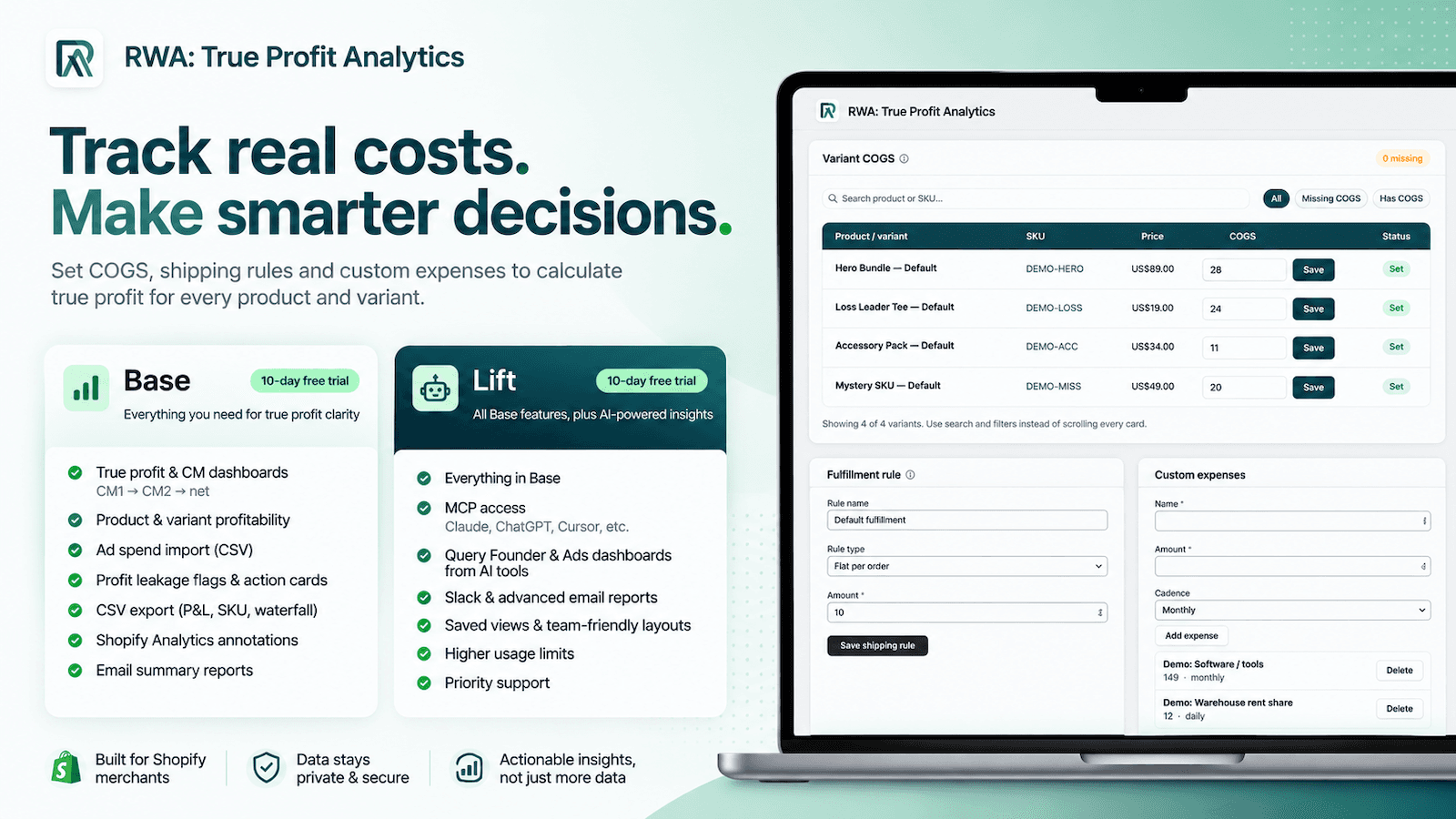
You can work this out in a spreadsheet, but it gets painful across hundreds of BFCM orders. RWA: True Profit Analytics is a Shopify app that does the calculation for every order.
- Profit per order and contribution margin after COGS, payment fees, shipping, returns, and ad spend.
- POAS by campaign next to spend, from a simple CSV ad spend import.
- Founder view with a P&L waterfall, plus action cards that flag where profit is leaking.
- CSV export of your P&L and SKU level profit.
- Ask AI tools about your numbers. The Lift plan adds MCP, so Claude, ChatGPT, or Cursor can query your profit data.
There is a 10-day free trial, so you can set it up before Black Friday and see your real numbers through Cyber Monday.
FAQ
What is a good profit per order on Shopify? It depends on your product and price point. The useful test is whether profit per order stays positive after ad spend. If it does not, the product needs a higher price, lower costs, or less ad spend per sale.
What is the difference between gross margin and contribution margin? Gross margin only takes out COGS. Contribution margin also takes out per order costs like payment fees, shipping, and returns, so it is closer to what each order really earns.
Should I include ad spend in profit per order? Yes, if you want true profit. Without it, a campaign can look profitable while it costs more to acquire each order than the order earns.
Is POAS better than ROAS? POAS uses profit instead of revenue, so it shows whether ads make money, not just sales. It is most useful when discounts and costs change a lot, like over BFCM.
When should I set up profit tracking for Black Friday? At least a week before 27 November, so your COGS and costs are in and you have a normal week to compare BFCM against.
Know your numbers before 27 November
A big Black Friday is only good news if the orders made money. Work out your true profit per order now, set your discount and ad spend limits, and track them daily through Christmas.